Did you know, guide Brian Milne and company have caught a handful of World Record-caliber sharks over the years?
According to the International Game Fish Association (IGFA), the all-tackle world record for a leopard shark was a 44-pound, 7-ounce, and 63-inch shark (5 feet, 3 inches), caught by Maria de la Luz Johnson in San Diego Bay in 2011.
Unfortunately, to record an all-tackle world record, in this case, the IGFA requires that the shark be weighed on land by a certified scale.
When kayak fishing the bay or open ocean, we would surely have to kill a shark to get it back to a certified scale on land, and we’re not willing to do that.
We only practice catch-and-release of sharks at CCFA, and have never killed one, and therefore haven’t submitted a world record.
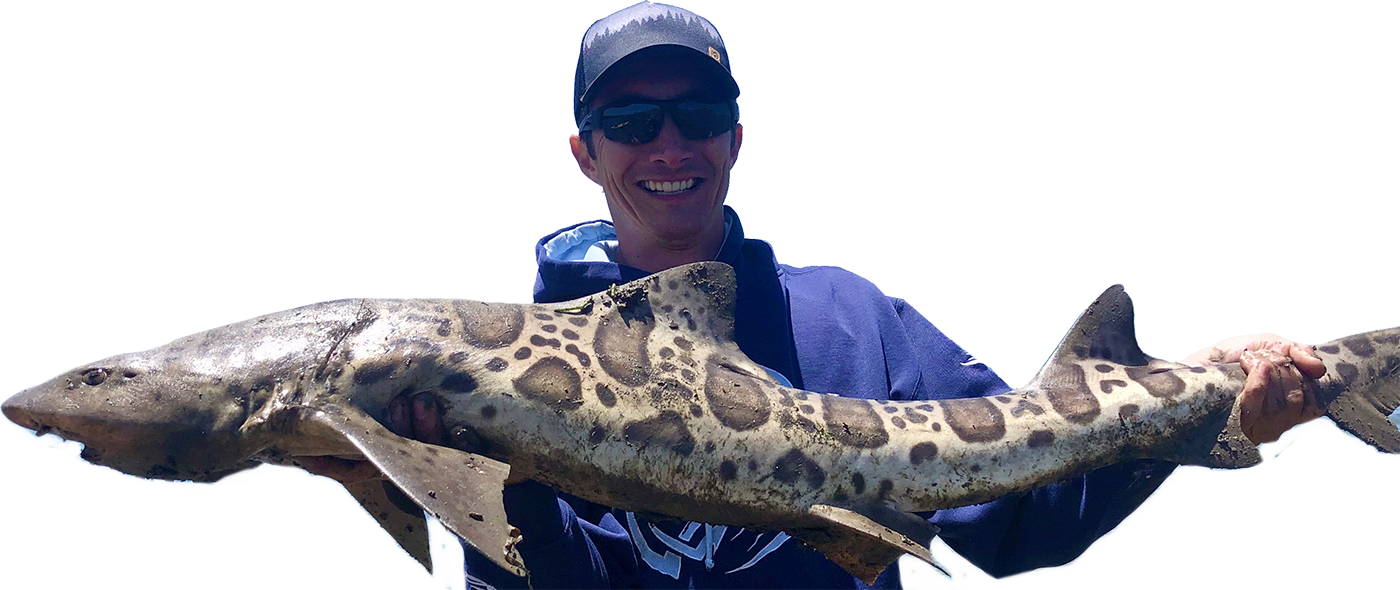
That said, we’ve caught a number of leopard sharks over 5’3″ and 45 pounds, and landed smoothhound and shovelnose sharks that would challenge various records.
But as dedicated catch-and-release anglers, our goal is to release sharks unharmed. And we don’t believe in killing sharks simply to have them weighed and certified, as many of these big sharks are females that don’t mate for the first 10 years of their lives, have a gestation period of 12 months and can carry as many as 36 pups at a time. (Think about that for a minute. Leopard sharks wait 10 years to mate, and, if you kill a large female, it’s likely in the middle of its 12-month gestation and you could be wiping out 37 sharks with one catch.)
At CCFA, we prefer to release these sharks to swim another day – leaving the IGFA untouched, but the possibility of finding an even bigger shark very much alive.
Ready to chase a world-record-sized leopard shark? Contact us to get on the water and pursue one of California’s true inshore giants … from a kayak!
DID YOU KNOW? Female leopard sharks typically don’t mate for their first 10 years, and only live 24 years on average. Leopard sharks are also ovoviviparous, which means they carry their eggs internally and give birth to live young (as many as 36 pups at a time) after a 12-month gestation period.
Because of their long reproductive cycle, we urge anglers to practice catch-and-release.